- Behavioural science
- Mornings
Why You Scroll in Bed Every Morning (It Isn't Weak Willpower)
Sleep inertia, automatic habits and dopamine-driven seeking explain why you lose 40 minutes to your phone every morning — and why willpower isn't the fix.
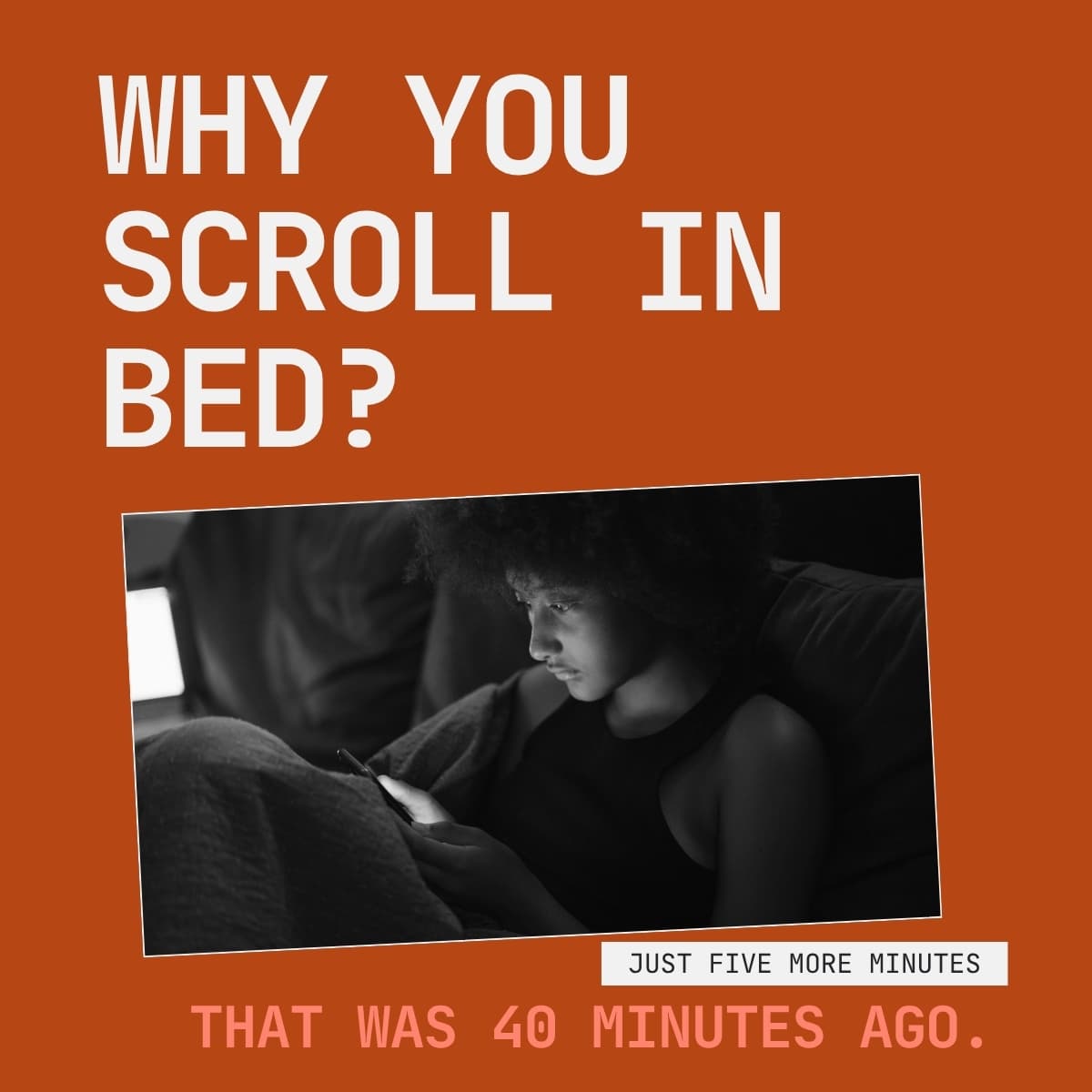
You set the intention last night. You meant it. You were going to get up, make coffee, maybe read for twenty minutes.
Then the alarm went off and forty minutes disappeared, and you're still horizontal, and you've read nothing but other people's opinions about things that don't concern you.
If this happens most mornings and you've concluded you're undisciplined, I'd like to offer a more accurate explanation. There are three things going on, none of them are character flaws, and only one of them can be fixed with effort.
1. Your self-control system isn't awake yet
There's a name for the state you're in when the alarm goes off: sleep inertia.
It's the period immediately after waking when cognitive and sensory-motor performance are still measurably impaired. Sleep researchers generally put this window at somewhere between 15 and 60 minutes, and it runs longer if you're carrying sleep debt or if you woke out of deep sleep rather than a lighter stage.
The part that matters: during that window, your prefrontal cortex — the region handling planning, impulse control, and self-regulation — is not fully online.
Read that again, because it explains almost everything.
The version of you who set the intention last night is not the version making decisions at 6:47am. Last night's you had a functioning prefrontal cortex. This morning's you is running on the parts of the brain that boot up first, and those parts do not do long-term planning. They do habit.
Asking that version of yourself to exercise willpower is like asking someone to sprint before they've stood up. It's not that they won't. It's that the system required isn't available yet.
2. The reach isn't a decision — it's an automatic sequence
Here's the second thing.
Alarm sounds. Hand moves. Screen lights up. Thumb finds the app.
Ask yourself honestly: where in that sequence did you decide anything?
Behavioural research on habit formation is consistent on this point — once a behaviour has been repeated enough times in a stable context, it stops requiring conscious thought each time it runs. The cue triggers the action directly. Deliberation drops out of the loop entirely.
Your morning phone reach has probably run several thousand times in an almost identical context: same room, same alarm, same position, same hand. It is one of the most heavily reinforced habit loops in your life. It fires before you've registered that you're awake.
So the two problems compound. The habit is automatic precisely when the system that could override it is offline. That's not bad luck; it's why mornings are uniquely hard, and why the same person who has decent self-control at 3pm has none at 6:47am.
3. The phone is exploiting a seeking loop, not a satisfaction one
Dopamine is popularly described as the pleasure chemical. That's not quite right, and the correction matters here.
Dopamine is better understood as driving seeking than satisfaction — the anticipation of a reward rather than the enjoyment of it. Feeds are engineered around this. The next post might be interesting. The notification might be something. The refresh might produce something new.
That's why a check that was supposed to take ten seconds becomes twenty minutes without ever feeling actively good. You're not enjoying it. You're seeking, and the loop doesn't terminate on its own because the reward is always one scroll away.
And in bed, it does something specific: it blunts the mild discomfort that would otherwise push you to get up. Being awake and horizontal is slightly unpleasant. Your body wants to move. A stream of small rewards makes that discomfort tolerable indefinitely — so the signal that would normally get you upright never gets loud enough.
What this costs you beyond the time
The forty minutes is the obvious cost. It's not the main one.
Before you've chosen a single priority of your own, you've absorbed other people's — messages, alerts, news, comparison content. You start the day reactive rather than directed, and the mental tone of those opening minutes tends to persist for hours.
There's reasonable evidence that this matters. A 2025 randomised controlled trial published in PNAS Nexus found that blocking mobile internet access for two weeks improved sustained attention, mental health, and subjective wellbeing — with 91% of participants improving on at least one of those three measures.
You don't have to block your internet for two weeks to take the point. The direction of the effect is clear.
Why "just don't check it" has never once worked
Now you can see why the standard advice fails.
"Just don't reach for your phone" asks the self-control system to intervene at the exact moment the self-control system is least available, against a behaviour that has stopped requiring decisions at all.
It's the wrong intervention aimed at the wrong mechanism at the worst possible time.
The behavioural literature points somewhere else entirely. The most durable interventions change the environment, not the intention. You don't get better at resisting the cue. You arrange things so the old behaviour is interrupted before it completes.
This is why people put the biscuits on a high shelf rather than resolving to want them less. The shelf works. The resolution doesn't.
What actually works: move before you unlock
There's one intervention with unusual leverage here, and it's this: get your body upright before your phone gets your attention.
Two reasons.
Physiologically, movement is among the fastest ways to clear sleep inertia. Even a short walk starts shifting blood flow and alertness. You are not going to think your way out of grogginess while lying still; you're going to move your way out of it.
Behaviourally, it flips the first action of the day from passive to active. Once your opening move is something you did rather than something you consumed, the rest of the morning is dramatically easier to steer. A small win at the start compounds.
The sequence that works is: upright, moving, daylight if you can get it — then phone. Not phone then upright.
Making the sequence enforce itself
The problem with knowing all of this is that knowing it doesn't help. You knew it before you read this. The gap isn't information; it's that the information isn't available to you at 6:47am.
So the sequence has to be enforced by something other than your intentions.
The good options, in rough order of effort:
Charge the phone in another room. Free, undefeated, and genuinely the best answer if you can tolerate it. Buy a £5 alarm clock. Most people won't do this, which is fine, but it's worth knowing it's the gold standard.
Give someone else your Screen Time passcode. Free. Converts a self-imposed rule into an externally-enforced one, which is structurally what the paid devices sell you. Almost nobody does this because it requires saying out loud that you can't manage it alone.
Buy a physical blocker. A Brick, Bloom, or Locked tag — an NFC device you leave in another room, so unlocking your apps requires walking to it. Around $39–59 once, no subscription. Genuinely effective, and the right answer if your problem runs all day rather than just at wake-up.
Use a free app that requires movement. This is what I built Rise for, so weigh accordingly: your chosen apps stay locked until you've walked 100 steps or photographed a real object across the room — your toothbrush, the kettle, the front door. You cannot walk 100 steps lying down, which is exactly the point. By the time your feed loads, you're already up, already moving, already through the worst of the inertia. See the two unlock methods.
It's free, there's no account, no ads, nothing to cancel. It's also iPhone-only, it only covers your wake-up window, and you could uninstall it if you were determined enough — it's friction, not a prison. If your scrolling problem runs all day, buy the hardware instead.
But if your problem is the specific one this article is about — the forty minutes between the alarm and standing up — it costs nothing to fix tonight, and takes about three minutes to set up.
Download Rise free on the App Store →
The reframe worth keeping
You are not undisciplined.
You've been trying to win a fight against an automatic habit, using a brain system that isn't switched on yet, at the one time of day when that habit is strongest. Losing that fight is the expected outcome. It would be strange if you won.
Stop trying to win it. Change the board instead — put one physical action between waking and unlocking, and let that action do the work your prefrontal cortex can't do yet.
Tomorrow morning genuinely can go differently. Not because you'll want it more than you did last night, but because you'll have arranged things so wanting it isn't required.
Sources: Trotti, Sleep Medicine Reviews (2017) on sleep inertia; Castelo et al., PNAS Nexus (2025) on mobile internet blocking; Wood & Neal on habit automaticity; Berridge & Robinson on dopamine and incentive salience; Reviews.org 2026 survey on morning phone use. I build Rise, which is mentioned above and is free.
Frequently asked questions
Why do I automatically scroll my phone when I wake up?
Two things compound. Sleep inertia means your prefrontal cortex — the part of your brain responsible for planning and impulse control — is still not fully online for the first 15 to 60 minutes after waking. At the same time, the morning phone reach has been repeated so many times in the same context that it runs as an automatic habit loop rather than a conscious decision, so it fires before self-control is available to stop it.
Is scrolling in bed actually a dopamine problem?
Dopamine drives seeking rather than satisfaction — the anticipation that the next post or notification might be interesting, not enjoyment of the one you're looking at. That's why a check meant to take ten seconds can stretch to forty minutes without ever feeling particularly good: the loop doesn't naturally terminate.
What actually stops morning phone scrolling?
Changing the environment rather than relying on willpower. The most effective single change is putting a physical action — standing up, walking, getting daylight — between waking and unlocking your phone, since willpower and intention-setting both rely on a self-control system that isn't fully awake yet.